


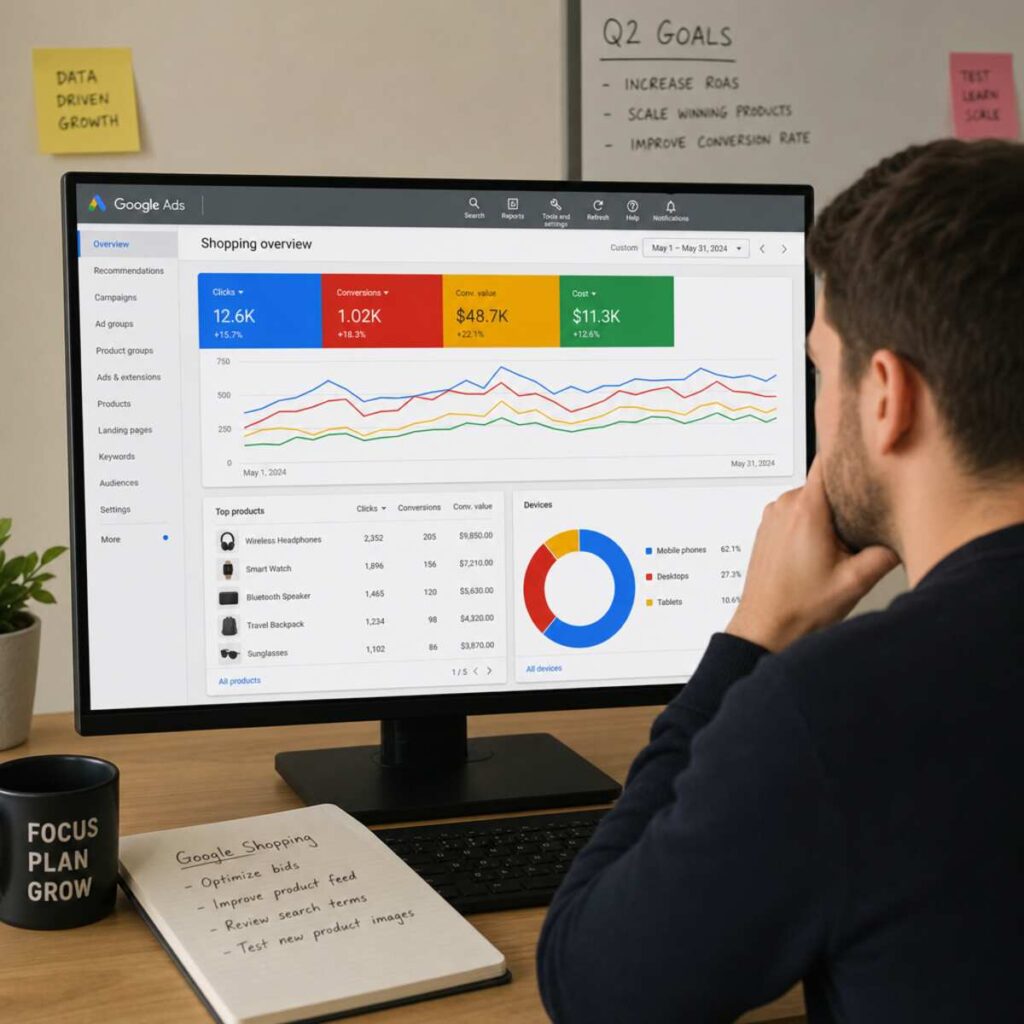
Turn Shopping Clicks Into Profitable Customers
Google Shopping is one of the fastest ways to put your products in front of buyers who are already searching with intent. But visibility alone does not create profit. If your product feed is messy, your bidding strategy is too broad, your campaign structure is weak, or your tracking is unreliable, you can spend heavily and still wonder where the revenue went.
That is where a focused Google Shopping Ads agency makes the difference.
We help ecommerce brands turn Google Shopping campaigns into disciplined, measurable growth engines. Our approach blends strategic account architecture, product feed optimization, conversion-focused analysis, and ongoing performance refinement so your ad spend works harder at every stage.
If you are looking for a google ads agency that treats ROI as the headline metric—not an afterthought—you are in the right place.
Ready to make your Shopping campaigns more profitable?
Request a Google Shopping Ads auditTalk to a PPC strategist
Built for Ecommerce Brands That Need More Than Clicks
Google Shopping Ads are not like standard search campaigns. Buyers see your image, price, product name, store, reviews, and offer before they click. That can make Shopping incredibly powerful—but also unforgiving.
A weak product title can limit visibility. Poor segmentation can push budget toward low-margin products. Incorrect conversion tracking can mislead every decision. A generic bidding strategy can chase revenue while ignoring profitability. And when everything is bundled together, it becomes nearly impossible to know which products deserve more budget and which are quietly draining spend.
Our ppc advertising services are designed around the ecommerce realities that matter:
- Product margins are not equal.
- New customers and returning customers may have different values.
- Revenue growth is not always profitable growth.
- Feed quality affects campaign performance.
- Campaign structure should support smarter optimization.
- Search terms, pricing, inventory, and seasonality all influence ROI.
- Tracking must be clean before decisions can be trusted.
We do not believe in “set it and forget it” Shopping campaigns. We believe in structured testing, clear reporting, and consistent improvement.
The Problem: Google Shopping Can Scale Spend Faster Than Profit
Many ecommerce teams come to us with the same frustration: Google Shopping is producing sales, but the numbers do not feel right.
Maybe your account shows revenue, yet profit margins are thin. Maybe Performance Max is spending aggressively, but you cannot tell which products are driving the best returns. Maybe you are getting traffic, but your conversion rate is inconsistent. Maybe you have tried increasing budget, only to watch efficiency fall.
The campaign looks active. The reports look busy. The spend keeps moving.
But ROI is not where it should be.
This usually happens because Shopping performance depends on multiple connected pieces. Campaigns are only one layer. Your feed, landing pages, conversion tracking, bidding, product segmentation, audience signals, promotional calendar, pricing, and inventory all influence results.
If one part is weak, the whole system can underperform.
Common issues include:
- Product titles that miss high-intent search terms
- Descriptions that fail to clarify product relevance
- Incorrect or incomplete product attributes
- Too many products grouped into one campaign without strategic segmentation
- Budget wasted on low-margin or low-converting products
- Smart bidding optimized around incomplete data
- Performance Max campaigns with limited visibility and weak asset strategy
- Campaigns measured only by ROAS, without considering gross margin or customer value
- Seasonal changes handled too late
- Poor alignment between ads, pricing, promotions, and landing pages
- Conversion tracking gaps that distort performance decisions
A strong google shopping ads agency looks beyond the platform interface. We examine the commercial logic behind your campaigns so every optimization supports the bigger business goal: profitable growth.
Our Value Proposition: More Control, Better Data, Stronger ROI
We help ecommerce brands maximize Google Shopping performance by improving the systems that drive profitable paid traffic.
That means we do not simply adjust bids and send reports. We build a smarter foundation for growth.
Our work focuses on four core outcomes:
1. Improve Revenue Quality
Not all revenue is equally valuable. A campaign that drives sales for low-margin products may look strong in Google Ads but underperform for your business. We help identify which products, categories, and customer segments deserve priority based on your goals.
Where possible, we align campaign decisions with deeper metrics such as margin, inventory availability, average order value, repeat purchase potential, and customer acquisition goals.
2. Reduce Wasted Spend
Waste in Google Shopping often hides in plain sight. It can come from irrelevant search terms, poor feed relevance, broad campaign grouping, weak exclusions, outdated products, inefficient bidding, or products that attract clicks but rarely convert.
We look for the leaks and help tighten the account so more of your budget goes toward products and searches with stronger commercial intent.
3. Strengthen Campaign Structure
Campaign structure determines how much control you have. If every product is treated the same, optimization becomes blunt. We structure campaigns around meaningful differences such as category, margin, performance tier, price point, seasonality, inventory, or business priority.
This gives your account a better chance to allocate spend intelligently.
4. Create Clearer Performance Visibility
You cannot scale confidently if you cannot trust the data. We review tracking, reporting, conversion actions, attribution considerations, and campaign segmentation so performance is easier to understand.
Our goal is to replace guesswork with clarity.
Who We Help
Our Google Shopping Ads management is built for ecommerce brands that want profitable scale—not vanity metrics.
We are a strong fit for:
- Ecommerce brands spending consistently on Google Ads but unhappy with ROI
- Online retailers ready to scale Shopping campaigns with better structure
- Brands running Performance Max but needing clearer strategy and control
- Businesses with large product catalogs that need smarter segmentation
- Teams that need a google ads agency with ecommerce-specific expertise
- Companies that want ppc advertising services connected to revenue and profitability
- Brands preparing for seasonal peaks, launches, or promotional periods
- Ecommerce teams that need better reporting and strategic guidance
You do not need a perfect account to work with us. In fact, most accounts have hidden opportunities. What you do need is a willingness to improve the full paid shopping system—not just the campaign settings.
What Makes Our Google Shopping Strategy Different
There are plenty of agencies that can launch campaigns. There are fewer that understand how product data, buyer intent, bidding automation, account structure, and ecommerce economics work together.
Our approach is built around practical performance strategy.
We Start With Business Goals, Not Platform Defaults
Google Ads offers recommendations. Some are useful. Some are too generic. We do not optimize your account simply to satisfy platform prompts.
We begin by understanding what growth actually means for your business. Are you trying to acquire new customers? Increase profitable revenue? Clear inventory? Improve category performance? Protect brand demand? Expand into new markets? Raise average order value?
The right answer changes the campaign strategy.
We Treat the Product Feed as a Performance Asset
Your product feed is not administrative housekeeping. It is the language Google uses to understand your catalog and match your products to searches.
Feed quality influences visibility, relevance, click-through rate, and conversion potential. We examine titles, descriptions, product types, custom labels, images, availability, pricing, GTINs, and attributes to identify ways the feed can better support campaign performance.
We Segment With Purpose
A one-size-fits-all Shopping setup can hold back profitable scale. We use segmentation to create better visibility and control.
Depending on your catalog and goals, this may include segmentation by:
- Product category
- Margin tier
- Historical performance
- Price point
- Inventory priority
- Seasonality
- Brand versus non-brand demand
- Bestseller status
- Promotional strategy
- New versus established products
The point is not to make the account complicated. The point is to make it manageable, measurable, and aligned with ROI.
We Use Automation Strategically
Automation can be powerful, but only when it is guided by clean data and clear goals. Smart bidding and Performance Max campaigns can help scale ecommerce results, but they also need the right inputs, structure, creative assets, audience signals, exclusions, and measurement approach.
We do not reject automation. We manage it with discipline.
We Report in Plain English
You should not need to decode your own marketing reports. Our reporting focuses on what changed, what it means, and what we are doing next.
We connect campaign metrics to business impact so you can see whether your paid media investment is moving in the right direction.
Our Google Shopping Ads Services
Our services are designed to cover the full performance ecosystem behind profitable Shopping campaigns. Whether you need a one-time audit, full management, or strategic support for an internal team, we can help you build a stronger path to ROI.
Google Shopping Campaign Management
We manage Google Shopping campaigns with a focus on profitable growth. This includes campaign setup, optimization, budget allocation, search term analysis, bidding strategy, product grouping, performance reviews, testing, and reporting.
Our management approach is proactive. We monitor performance patterns, identify areas for improvement, and make adjustments based on data—not assumptions.
Key areas include:
- Campaign structure and setup
- Product group strategy
- Budget management
- Bid strategy recommendations
- Search term review and exclusions where applicable
- Product-level performance analysis
- Category and margin-based optimization
- Promotion and seasonality planning
- Ongoing testing and refinement
Performance Max for Ecommerce
Performance Max can drive meaningful ecommerce growth, especially when supported by strong product data and clear conversion tracking. But without the right strategy, it can also become a black box that spends budget without enough insight.
We help ecommerce brands use Performance Max more intelligently.
Our work may include:
- Campaign structure recommendations
- Asset group planning
- Product segmentation
- Audience signal development
- Feed optimization for Performance Max
- Budget allocation strategy
- Creative asset guidance
- Brand and non-brand considerations
- Reporting interpretation
- Incremental testing recommendations
We focus on making Performance Max part of a broader paid media strategy rather than a campaign you simply turn on and hope for the best.
Product Feed Optimization
A stronger feed can improve relevance, visibility, and campaign efficiency. We review your product data to identify technical and strategic improvements that may help Google better match your products with qualified shoppers.
Feed optimization may include:
- Product title improvements
- Description refinement
- Product type organization
- Google product category review
- Custom label strategy
- Attribute completion
- GTIN and identifier checks
- Price and availability consistency
- Image quality recommendations
- Promotional feed considerations
A feed that is clear, complete, and strategically structured gives your campaigns a stronger foundation.
Google Merchant Center Support
Google Merchant Center issues can interrupt performance quickly. Disapprovals, data mismatches, missing attributes, policy warnings, and feed errors can prevent products from serving or reduce catalog coverage.
We help identify and resolve Merchant Center issues that affect Shopping performance.
Support may include:
- Feed diagnostics review
- Product disapproval investigation
- Attribute and data quality recommendations
- Policy issue guidance
- Shipping and tax setting review
- Product availability checks
- Merchant Center and Google Ads connection review
The goal is simple: keep your products eligible, accurate, and ready to compete.
Shopping Ads Account Audits
If you are not sure whether your account is set up correctly, a structured audit can reveal immediate opportunities.
Our Google Shopping Ads audits review the major drivers of performance, including campaign structure, feed quality, tracking, bidding, search terms, product segmentation, budget allocation, and reporting.
You receive clear findings and practical recommendations—not a confusing spreadsheet of minor notes.
An audit is ideal if:
- Your ROAS has declined
- Spend has increased but profit has not
- You are unsure whether Performance Max is helping or hiding issues
- You recently migrated campaign structures
- Your product catalog has expanded
- Your team needs an outside expert review
- You are comparing ppc advertising services and want clarity before committing
Conversion Tracking and Measurement Review
Good optimization requires good data. If conversion tracking is inaccurate, every automated strategy and every manual decision is affected.
We review the measurement setup to help ensure the account is working with reliable performance signals.
This may include:
- Conversion action review
- Purchase tracking validation guidance
- Revenue tracking review
- Duplicate conversion checks
- Primary and secondary conversion action review
- Attribution consideration
- Enhanced conversion recommendations where relevant
- Analytics and Google Ads alignment review
We do not want your campaigns optimizing toward broken signals. Clean measurement is one of the most important foundations of profitable growth.
Search and Shopping Integration
Shopping campaigns are powerful, but they rarely operate in isolation. Text search campaigns can capture demand that Shopping misses. Brand campaigns can protect high-intent traffic. Remarketing and audience strategies can support the full customer journey.
As a google ads agency, we look at how your paid search ecosystem works together.
This may include:
- Branded search strategy
- Non-brand search opportunities
- Competitor search considerations
- Dynamic search campaign review
- Landing page alignment
- Budget split recommendations
- Cross-campaign query insights
- Funnel coverage analysis
The goal is not to run more campaigns for the sake of complexity. The goal is to make sure your Google Ads strategy captures profitable demand at the right moments.
Landing Page and Conversion Strategy
Your ads can bring shoppers to the site, but your product pages must earn the sale. If clicks are qualified but conversion rates are low, the issue may not be the campaign alone.
We review conversion factors that influence Shopping performance, including:
- Product page clarity
- Pricing and offer presentation
- Shipping and returns messaging
- Trust signals
- Product imagery
- Reviews and social proof
- Mobile experience
- Page speed considerations
- Checkout friction
- Promotion alignment
Small improvements to conversion rate can have a significant impact on paid media ROI.
Our Process: From Audit to Profitable Optimization
We use a structured process designed to uncover opportunities, prioritize action, and improve performance over time.
Step 1: Discovery and Goal Alignment
We begin by understanding your business model, product catalog, margins, average order value, sales cycle, customer segments, and growth goals.
This step helps us answer critical questions:
- What does profitable growth mean for your business?
- Which products or categories matter most?
- Are there margin differences we should consider?
- Are you focused on new customer acquisition, total revenue, or profit efficiency?
- What seasonal or promotional factors affect performance?
- What internal constraints should we know about?
Without this context, optimization can become too narrow. We want campaign decisions to support business outcomes.
Step 2: Account and Feed Audit
Next, we review the current state of your Google Ads account, Shopping campaigns, Merchant Center, product feed, tracking, and reporting.
We look for structural issues, missed opportunities, inefficient spend patterns, and measurement gaps.
The audit typically examines:
- Campaign organization
- Budget allocation
- Product-level performance
- Product feed completeness
- Merchant Center issues
- Conversion tracking
- Bid strategy alignment
- Search term quality
- Landing page experience
- Historical performance trends
- Performance Max configuration if applicable
This gives us a practical roadmap for improvement.
Step 3: Strategy Development
After the audit, we build a strategy based on your current performance and growth goals.
This may include recommendations for campaign restructuring, product segmentation, feed improvements, bidding adjustments, tracking cleanup, budget reallocation, testing priorities, and reporting changes.
We focus on what matters most first. Not every issue has equal impact. A strong strategy separates urgent revenue leaks from secondary refinements.
Step 4: Implementation
Once the strategy is approved, we implement the agreed improvements.
Depending on the account, implementation may include:
- Rebuilding campaign structure
- Creating product segments
- Updating product feed recommendations
- Adjusting budgets
- Refining bidding strategies
- Improving asset groups
- Setting exclusions where available and appropriate
- Reviewing conversion actions
- Aligning campaigns with promotions
- Preparing launch or seasonal campaigns
We make changes carefully and intentionally. The goal is to improve control and performance without unnecessary disruption.
Step 5: Optimization and Testing
Google Shopping performance changes constantly. Competitors adjust prices. Demand shifts. Inventory changes. Promotions come and go. Search behavior evolves. Automation learns from new data.
That is why ongoing optimization matters.
We monitor performance and test improvements across areas such as:
- Product segmentation
- Feed title variations
- Budget allocation
- Bid strategy targets
- Promotional messaging
- Campaign priority
- Creative assets for Performance Max
- Search term exclusions
- Landing page alignment
- Category-specific opportunities
Optimization is not random activity. Each test should answer a performance question.
Step 6: Reporting and Strategic Reviews
You receive clear reporting that explains what happened, why it matters, and what we recommend next.
We review performance through the lens of your goals, not just platform metrics. Where available, we may analyze revenue, ROAS, cost, conversions, conversion rate, average order value, product performance, category trends, and efficiency changes.
Our reports are designed to help you make smarter decisions about budget, inventory, promotions, and growth.
What You Can Expect From Working With Us
When you hire a google shopping ads agency, you should expect more than task completion. You should expect strategic ownership.
Here is what our clients value about our approach.
Clear Priorities
We help you understand what matters most. Instead of overwhelming you with every possible adjustment, we prioritize the changes most likely to improve performance.
Practical Strategy
We do not hide behind jargon. We explain the logic behind recommendations and connect them to business outcomes.
Proactive Management
We monitor performance, identify opportunities, and recommend next steps. You should not have to chase your agency for strategic ideas.
Transparent Communication
You know what we are working on, why we are doing it, and how it affects your goals. If performance changes, we explain what we see and what we plan to do.
Ecommerce-Specific Thinking
Shopping Ads require product-level thinking. We consider feed quality, pricing, inventory, margins, category performance, and buyer intent—not just clicks and impressions.
ROI Discipline
We are not impressed by spend for the sake of spend. We want campaigns that contribute to profitable growth.
Why ROI in Google Shopping Requires a Full-Funnel View
It is tempting to measure Google Shopping success by a single number. ROAS is useful, but it does not always tell the whole story.
A campaign with a high ROAS may be spending only on brand demand you would have captured anyway. A campaign with a lower ROAS may be bringing in new customers with strong lifetime value. A product with excellent revenue may have weak margins. A product with modest volume may be highly profitable.
That is why ROI-focused Shopping management looks at the full picture.
Important questions include:
- Which products create the healthiest margin?
- Which campaigns bring in new customers?
- Which searches indicate strong purchase intent?
- Which categories scale efficiently?
- Which products generate repeat purchases?
- Which promotions improve conversion without hurting profit?
- Which products should not receive more spend?
- Which landing pages reduce buyer hesitation?
- Which campaigns are capturing demand versus creating incremental growth?
The more clearly we answer these questions, the better your Google Shopping strategy becomes.
Shopping Campaigns and Performance Max: Finding the Right Balance
Many ecommerce brands now rely heavily on Performance Max. It can be effective, but it also changes how advertisers manage visibility and control.
A strong strategy does not ask, “Should we use Performance Max or Shopping?” It asks, “What structure gives this business the best chance to scale profitably?”
For some brands, Performance Max may be the primary engine. For others, a more segmented approach may be useful. Some accounts need separate campaigns for priority categories. Others need careful feed labels and asset group organization. Some need search campaigns to support gaps in Shopping coverage.
The right mix depends on your catalog, budget, data volume, margins, brand strength, and goals.
We help you navigate that decision with a practical framework rather than a default setting.
Product Feed Optimization: The Quiet Lever Behind Better Shopping Results
Your product feed is one of the most overlooked growth levers in ecommerce PPC.
Campaign settings matter, but Google Shopping relies heavily on product data. If your feed does not clearly describe what you sell, your campaigns may miss relevant searches or compete inefficiently.
A strong feed helps answer three important questions:
- What is the product?
- Who is it for?
- Which searches should it match?
Product titles should be clear and search-relevant. Descriptions should support context. Attributes should be complete. Product types and custom labels should create useful organization. Images should be compelling and accurate. Pricing and availability should be consistent.
Feed improvements can support better visibility, cleaner segmentation, and smarter optimization.
For example, a generic title may not include the details shoppers use when searching. A stronger title might include product type, brand, key feature, material, size, gender, or use case where relevant. The goal is not to stuff keywords. The goal is to communicate clearly in the language buyers use.
That is the difference between basic feed management and performance-focused feed strategy.
Smarter Segmentation for Smarter Spend
One of the biggest mistakes in Google Shopping is treating every product equally.
Your catalog likely contains products with different margins, conversion rates, price points, inventory levels, and strategic importance. Some products are bestsellers. Some are seasonal. Some are entry-level acquisition products. Some are premium products that need more consideration. Some products attract clicks but rarely convert.
Segmentation helps your campaigns reflect these differences.
Useful segmentation may include:
- Bestsellers: Products with proven demand and conversion history
- High-margin products: Items that can tolerate higher acquisition costs
- Low-margin products: Items that require stricter efficiency targets
- New products: Products that need testing and data collection
- Seasonal products: Items that require timed budget shifts
- Clearance products: Inventory that may need promotion-based strategy
- Premium products: Higher-ticket items that may need longer funnel support
- Low-performing products: Items that need feed, pricing, page, or budget review
Segmentation gives you better levers. Better levers create better decisions.
Budget Allocation That Supports Profit, Not Just Volume
Increasing budget is easy. Scaling profitably is harder.
Before adding spend, we examine where the current budget is going. Are campaigns limited by budget while profitable products are underfunded? Are low-value products consuming spend? Are brand-heavy campaigns inflating overall ROAS? Are seasonal winners getting enough visibility at the right time? Are high-margin categories receiving appropriate investment?
A stronger budget strategy may involve shifting spend toward:
- Products with better conversion rates
- Categories with stronger margins
- Campaigns with clearer incremental value
- Seasonal opportunities
- New customer acquisition campaigns
- Promotions with proven performance
- Product groups with scalable demand
It may also mean reducing spend on products or campaigns that do not support your commercial goals.
Our role is to help your budget behave like an investment, not an expense.
Conversion Tracking: The Foundation of Reliable Optimization
Every paid media strategy depends on the quality of its measurement.
If Google Ads is receiving incomplete, duplicated, or inaccurate conversion data, bidding decisions can become unreliable. Smart bidding depends on signals. Reporting depends on tracking. Budget decisions depend on attribution. If the data is wrong, the strategy can drift.
That is why we review tracking before making major optimization decisions.
Important measurement questions include:
- Are purchases tracked correctly?
- Is revenue passing accurately?
- Are conversions duplicated?
- Are the right conversion actions marked as primary?
- Are micro-conversions interfering with bidding?
- Is Google Ads aligned with analytics reporting?
- Are tracking changes documented?
- Is attribution being interpreted correctly?
Reliable tracking gives your campaigns a cleaner signal and gives your team more confidence in the results.
Landing Pages Matter More Than Many Advertisers Realize
Google Shopping sends users directly to product pages. That means your product pages are often your first impression, sales pitch, trust builder, and checkout gateway all at once.
If your product page creates friction, your ads pay for it.
A strong product page should answer buyer questions quickly:
- What is this product?
- Is it right for me?
- What makes it different?
- Is the price fair?
- Can I trust this store?
- How fast will it ship?
- What happens if I need to return it?
- Are there reviews or proof points?
- Is checkout simple?
Campaign optimization can improve traffic quality, but landing page improvements can help turn that traffic into revenue.
As part of our PPC advertising services, we look for conversion barriers that may be limiting Shopping performance. We may recommend improvements to imagery, messaging, product details, trust signals, shipping clarity, review placement, mobile usability, or promotional alignment.
Better ads plus better pages create stronger ROI potential.
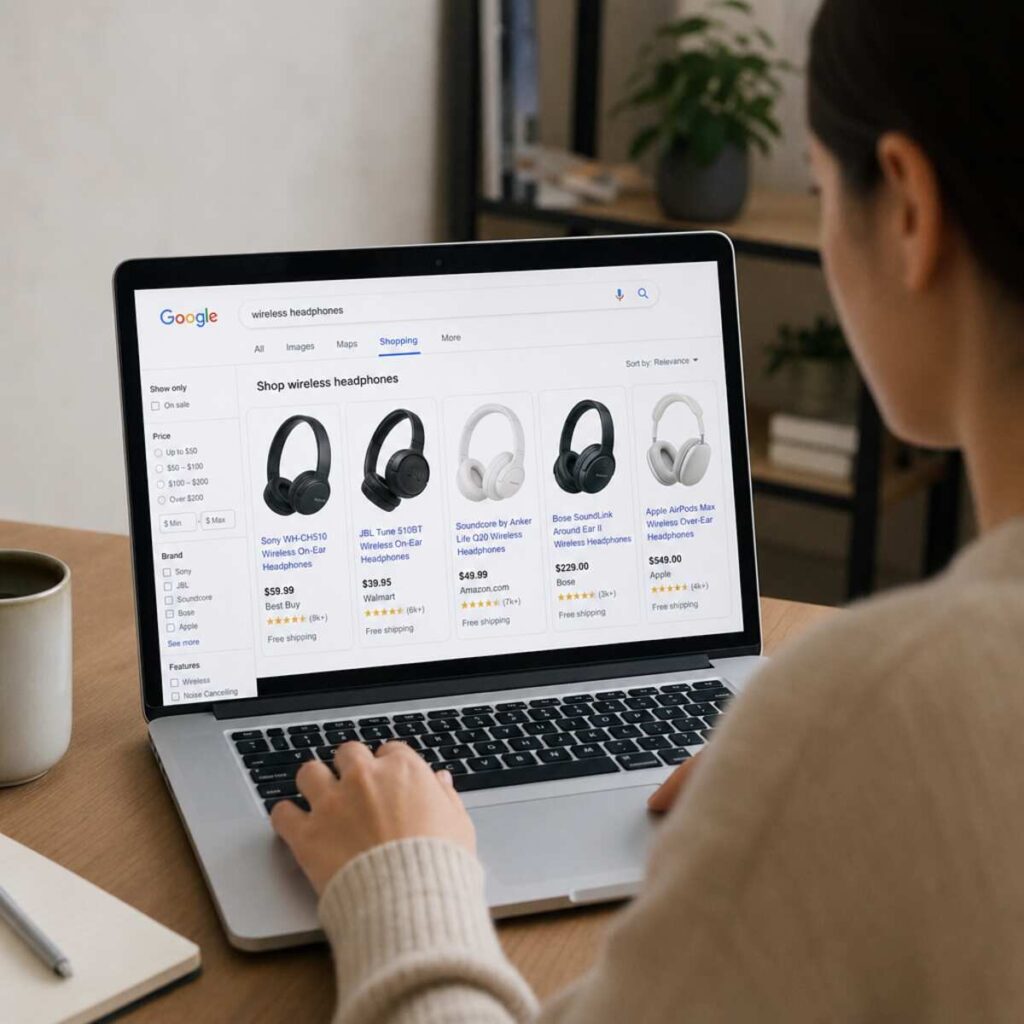
Trust Signals: Why Brands Choose Our Approach
Choosing a google ads agency is not just about who can access your account. It is about who can make sense of the numbers, protect your budget, and guide your next move.
Our approach is built on trust, clarity, and disciplined execution.
Strategic Audits Before Major Changes
We do not make sweeping changes without understanding your account. We begin with analysis so recommendations are grounded in evidence.
Transparent Roadmaps
You receive a clear view of priorities, planned improvements, and the reasoning behind each step.
Performance-Focused Reporting
Our reporting is built to explain progress, risks, opportunities, and next actions. We focus on business-relevant metrics, not vanity dashboards.
Product-Level Thinking
We analyze performance at the product and category level whenever possible. This helps uncover where profit is being created or lost.
Practical Communication
We translate campaign complexity into clear recommendations. You will understand what we are doing and why it matters.
Continuous Improvement
Google Shopping is not static. We watch for performance shifts, test improvements, and refine strategy as data develops.
Respect for Your Budget
We treat ad spend as an investment. Every recommendation should have a clear strategic purpose.
Questions We Help You Answer
The right agency relationship should make your decisions easier.
We help ecommerce teams answer questions such as:
- Are our Google Shopping campaigns structured correctly?
- Is Performance Max helping us scale or hiding wasted spend?
- Which products deserve more budget?
- Which products should be limited, paused, or reworked?
- Is our product feed holding us back?
- Are we over-relying on branded demand?
- Are our ROAS targets realistic based on margin?
- Are we tracking purchases and revenue correctly?
- What should we test next?
- Can we scale without sacrificing profitability?
- How should we prepare for seasonal demand?
- Are our landing pages converting qualified traffic effectively?
If you have been asking these questions internally, it may be time for expert support.
Signs Your Google Shopping Account Needs Help
You do not need to wait until performance collapses to improve your campaigns. Often, the best time to optimize is when campaigns are working—but not working as well as they could.
You may need a google shopping ads agency if:
- Your spend is increasing faster than revenue
- Your revenue is increasing but profit is not
- Your ROAS has declined without a clear explanation
- You cannot tell which products are driving performance
- Performance Max feels like a black box
- Your product feed has not been strategically optimized
- Merchant Center errors keep appearing
- You are unsure whether conversion tracking is accurate
- You have too many products in one broad campaign
- Your best products are not getting enough visibility
- Your agency reports clicks and impressions but not strategic insight
- You are preparing for a major sales season and need a stronger plan
- Your internal team needs expert PPC support
These issues are common. They are also fixable with the right strategy.
Why Work With a Specialized Google Shopping Ads Agency?
A generalist marketing partner may understand digital advertising broadly. But Google Shopping requires a specialized skill set.
Shopping performance depends on:
- Feed quality
- Product relevance
- Campaign structure
- Merchant Center health
- Bidding strategy
- Product segmentation
- Pricing competitiveness
- Inventory accuracy
- Conversion tracking
- Product page experience
- Seasonality
- Category economics
- Automation management
That is a lot of moving parts.
A specialized agency understands how these pieces interact. We know that improving ROI may require more than changing a bid target. It may require restructuring product groups, improving custom labels, adjusting feed titles, reviewing low-margin spend, separating campaign objectives, or cleaning up tracking.
That broader view is what allows optimization to become strategic.
A Better Way to Manage Google Shopping Growth
Many ecommerce brands fall into one of two extremes.
Some micromanage campaigns so heavily that they never allow automation or data to work properly. Others hand everything to automation and lose strategic control.
We believe the best path is guided automation.
That means giving Google’s systems strong data, clear conversion signals, useful segmentation, quality assets, and business-aligned goals. It also means monitoring outcomes carefully and intervening when performance data shows a better path.
Guided automation helps balance scale and control.
Our role is to create the conditions where your campaigns can learn effectively, spend intelligently, and support your business goals.
Our ROI Framework for Google Shopping Ads
While every account is different, our ROI framework is consistent. We look at performance through five connected lenses.
1. Relevance
Are your products showing for searches that match buyer intent? Relevance is influenced by feed data, campaign structure, search behavior, and product attributes.
2. Efficiency
Are you paying too much for the revenue you generate? Efficiency includes ROAS, cost per conversion, conversion rate, and budget waste.
3. Profitability
Are campaigns supporting profitable outcomes after considering margin, average order value, and product mix? Revenue alone is not enough.
4. Scalability
Can the account grow without efficiency collapsing? Scalability depends on demand, structure, data volume, bidding strategy, and product-market fit.
5. Visibility
Can your team understand what is happening? Visibility requires clear tracking, reporting, segmentation, and analysis.
When these five areas improve together, Google Shopping becomes easier to manage and more likely to produce meaningful ROI.
What Happens After You Request an Audit?
We make the next step simple.
When you request a Google Shopping Ads audit, we review your current situation and determine where expert support can create the most value.
The process typically includes:
- Introductory conversation We learn about your business, goals, product catalog, current challenges, and ad spend.
- Account access and data review With appropriate access, we review campaign structure, Shopping performance, Merchant Center signals, tracking, and feed-related opportunities.
- Opportunity analysis We identify areas where your account may be wasting spend, missing demand, or lacking strategic control.
- Strategic recommendations We share practical next steps based on what we find.
- Management or consulting proposal If there is a strong fit, we recommend the support model that best matches your needs.
There is no pressure to commit before you understand the opportunity. The first goal is clarity.
Built for Marketing Leaders, Founders, and Ecommerce Teams
Different stakeholders care about different outcomes.
A founder may want confidence that paid media spend is producing profitable growth. A marketing director may need clearer reporting and strategic execution. An ecommerce manager may need product-level insight. A finance leader may want better budget discipline. An internal PPC specialist may need expert support on Shopping structure or feed optimization.
Our work helps align those needs.
We communicate in a way that gives each stakeholder useful clarity:
- Executives get a clear view of growth and efficiency.
- Marketing teams get strategic direction and execution support.
- Ecommerce teams get product-level insights.
- Finance teams get stronger budget visibility.
- Internal specialists get practical collaboration.
Good Google Shopping management should create confidence across the business.
Beyond ROAS: Metrics That Matter
ROAS is important, but it is not the only metric that matters. Depending on your goals, we may also examine:
- Revenue
- Gross margin considerations
- Cost
- Conversion rate
- Average order value
- New customer revenue
- Returning customer revenue
- Product-level profitability
- Category performance
- Impression share trends
- Click-through rate
- Search term quality
- Budget utilization
- Cart and checkout behavior
- Inventory availability
- Customer lifetime value indicators
The right measurement mix depends on your business model. Our job is to help you focus on the metrics that best reflect real performance.
Common Google Shopping Mistakes We Help Fix
Many accounts underperform because of avoidable mistakes. Here are some of the most common issues we see.
Mistake 1: Using Generic Product Titles
Product titles that lack useful detail can limit relevance. We help identify opportunities to make titles clearer, more searchable, and more aligned with buyer intent.
Mistake 2: Ignoring Custom Labels
Custom labels can be powerful for segmentation. They can help organize products by margin, seasonality, performance, price tier, or business priority.
Mistake 3: Treating All Products the Same
Different products deserve different strategies. We help separate winners, test candidates, and budget drains.
Mistake 4: Trusting Automation Without Direction
Automation needs strong inputs. Without good data, clear goals, and thoughtful structure, automated campaigns may optimize in ways that do not match your business priorities.
Mistake 5: Measuring Only Platform Revenue
If your account optimizes only for tracked revenue without margin context, it may push spend toward products that look good in reports but contribute less profit.
Mistake 6: Overlooking Merchant Center Issues
Disapprovals and feed errors can quietly reduce visibility. Merchant Center health should be monitored consistently.
Mistake 7: Weak Landing Pages
If product pages do not answer buyer questions, qualified clicks can still fail to convert.
Mistake 8: Poor Seasonal Planning
Waiting until peak season starts is often too late. Strong campaigns need preparation before demand rises.
Seasonal and Promotional Shopping Strategy
For many ecommerce brands, seasonal periods can make or break annual performance. Holiday shopping, category-specific peaks, product launches, clearance events, and promotional campaigns all require careful planning.
A strong seasonal Google Shopping strategy includes:
- Reviewing historical seasonal data
- Identifying priority products and categories
- Preparing product feeds early
- Checking Merchant Center health
- Aligning promotions with landing pages
- Adjusting budgets before demand spikes
- Testing creative assets where relevant
- Monitoring inventory availability
- Reviewing shipping deadlines and messaging
- Planning post-promotion budget adjustments
Seasonal success is rarely accidental. It comes from preparation, timing, and disciplined optimization.
How We Approach Scaling
Scaling Google Shopping Ads is not simply a matter of increasing budget. If the foundation is weak, more budget can amplify inefficiency.
Before scaling, we look for signs that the account is ready:
- Tracking is reliable
- Product feed quality is strong enough
- Campaign structure supports control
- Key products have proven conversion history
- Budget is already allocated efficiently
- Landing pages are converting adequately
- Bidding strategy aligns with business goals
- Merchant Center issues are under control
- Performance is stable enough to expand responsibly
When these conditions are in place, scaling becomes more strategic.
Scaling may involve:
- Increasing budget for proven product segments
- Expanding category coverage
- Testing new campaign structures
- Improving feed coverage
- Launching complementary search campaigns
- Supporting new product launches
- Adjusting targets based on growth stage
- Expanding creative and audience inputs for Performance Max
Our goal is to scale with control, not chaos.
Why Clear Communication Matters in PPC
Paid media is full of moving parts. Without clear communication, even good work can feel confusing.
We believe you should always understand:
- What changed in the account
- Why it changed
- What the expected impact is
- What risks we are watching
- What results we are seeing
- What we recommend next
This is especially important with Google Shopping because performance can shift for many reasons, including auction competition, feed changes, pricing, inventory, seasonality, tracking updates, or site conversion issues.
We help interpret those signals so your team is not left guessing.
What Makes a Good Agency Partnership?
The best agency relationships are built on shared goals, timely communication, and mutual accountability.
We bring the PPC expertise. You bring product knowledge, business context, margin realities, inventory insight, and customer understanding. Together, we create a strategy that is more informed than either side could build alone.
A strong partnership includes:
- Clear goals
- Access to reliable data
- Open communication about business priorities
- Timely feedback on recommendations
- Willingness to test and learn
- Honest discussion about constraints
- Regular review of performance
When the partnership is aligned, Google Shopping optimization becomes much more effective.
Comparing PPC Advertising Services? Ask These Questions
If you are evaluating agencies, do not choose based only on who promises the highest ROAS. Ask better questions.
Consider asking:
- How do you evaluate product-level performance?
- How do you approach feed optimization?
- How do you decide campaign structure?
- How do you manage Performance Max?
- How do you handle margin differences?
- How do you reduce wasted spend?
- What does your reporting include?
- How do you validate conversion tracking?
- How often do you review search term quality?
- How do you plan for seasonality?
- How do you communicate strategy and next steps?
The answers will tell you whether the agency is simply managing settings or thinking strategically about your ecommerce growth.
Get a Google Shopping Strategy Built Around ROI
Your products deserve more than generic campaign management. Your budget deserves more than automated guesswork. Your team deserves a partner who can explain what is happening, identify what needs to improve, and build a practical path toward better returns.
If you need a google shopping ads agency that understands ecommerce performance, product feed strategy, campaign structure, and ROI-focused optimization, let’s talk.
We will help you uncover what is working, what is wasting spend, and what needs to happen next.
Request your Google Shopping Ads audit today.
Schedule a strategy callRequest an account review
Frequently Asked Questions
What does a Google Shopping Ads agency do?
A Google Shopping Ads agency helps ecommerce brands plan, manage, and optimize Shopping campaigns. This can include product feed optimization, Merchant Center support, campaign structure, bidding strategy, Performance Max management, product segmentation, conversion tracking review, reporting, and ongoing performance improvement.
The goal is to help your products appear for relevant searches and convert paid traffic into measurable revenue and profit.
How are Google Shopping Ads different from regular search ads?
Google Shopping Ads show product-specific information such as image, price, store name, product title, and reviews when available. Regular search ads are text-based and usually drive users to broader landing pages.
Shopping Ads depend heavily on product feed quality, Merchant Center setup, product relevance, and ecommerce conversion factors. That is why Shopping requires a more product-focused strategy than standard search campaigns.
Do I need a google ads agency if I already use Performance Max?
Yes, many brands still benefit from agency support even if they use Performance Max. Performance Max can automate placements and bidding, but it still needs strong product data, campaign structure, audience signals, creative assets, conversion tracking, and strategic oversight.
An agency can help make sure automation is working toward the right business goals instead of simply spending budget.
Can you help improve my product feed?
Yes. Product feed optimization is one of the core parts of our Google Shopping strategy. We review titles, descriptions, product types, categories, attributes, identifiers, custom labels, pricing, availability, and other feed elements that may affect campaign performance.
A better feed can help improve relevance, segmentation, and overall campaign quality.
What is a good ROAS for Google Shopping Ads?
A good ROAS depends on your margins, operating costs, average order value, customer lifetime value, and growth goals. A high ROAS is not automatically good if it limits scale or focuses only on existing demand. A lower ROAS may still be acceptable if it brings in valuable new customers or supports strategic growth.
We help you define performance targets based on your business economics, not generic benchmarks.
How long does it take to improve Google Shopping performance?
The timeline depends on your current account condition, data volume, product catalog, tracking setup, feed quality, and competitive environment. Some improvements, such as fixing disapprovals or reducing obvious wasted spend, may create faster impact. Broader improvements, such as restructuring campaigns or training automated bidding, often require more time and data.
We focus on building sustainable improvement rather than chasing short-term changes that create instability.
Do you manage both Standard Shopping and Performance Max?
Yes. We can help with Standard Shopping, Performance Max, or a combined strategy depending on your goals and account structure. The right setup depends on your catalog, budget, performance history, visibility needs, and growth objectives.
We recommend the structure that gives your business the best chance to improve ROI.
Can you work with our internal marketing team?
Yes. We can collaborate with internal teams through full management, consulting, audits, or strategic support. If your team already handles some PPC work, we can provide specialized Google Shopping expertise, feed strategy, reporting insight, or campaign recommendations.
The engagement can be shaped around your team’s needs.
What information do you need to start?
To begin, we typically need to understand your business goals, product catalog, target markets, current Google Ads performance, Merchant Center setup, conversion tracking, and any margin or product priority information you can share.
If you request an audit, we will guide you through the access and discovery steps.
Do you guarantee specific results?
No responsible agency should guarantee exact ad performance. Results depend on many factors, including competition, pricing, product demand, website conversion rate, margins, seasonality, tracking quality, and budget.
What we can promise is a strategic, transparent, and disciplined approach focused on improving the factors that influence ROI.
How do you reduce wasted spend in Google Shopping?
We reduce wasted spend by reviewing product-level performance, search term quality, feed relevance, campaign segmentation, bid strategy, budget allocation, and conversion tracking. We look for products or queries that consume budget without supporting your goals and recommend ways to limit, restructure, or improve them.
The goal is to shift more budget toward traffic with stronger commercial value.
Why is Merchant Center important for Shopping Ads?
Merchant Center is where your product data lives. If there are feed errors, disapprovals, missing attributes, pricing mismatches, or availability issues, your Shopping campaigns can lose visibility or serve inefficiently.
A healthy Merchant Center setup helps ensure your products are eligible and accurately represented.
How do you report on performance?
We provide clear reporting focused on performance trends, strategic insights, and next steps. Depending on your goals and available data, reporting may include revenue, spend, ROAS, conversion rate, average order value, product performance, category performance, search term insights, and budget recommendations.
Most importantly, we explain what the numbers mean.
Are your ppc advertising services only for ecommerce?
Our Google Shopping services are specifically built for ecommerce brands and online retailers. We may also support related Google Ads campaigns such as branded search, non-brand search, remarketing, or Performance Max when they support the ecommerce growth strategy.
What makes your approach ROI-focused?
We look beyond clicks and impressions. We evaluate product performance, margin considerations where available, conversion quality, tracking accuracy, campaign structure, feed quality, and budget allocation. Our recommendations are designed to help your ad spend generate stronger business outcomes.
ROI-focused management means every optimization should have a reason tied to performance.
Ready to Make Google Shopping Work Harder?
If your campaigns are spending but not scaling profitably, now is the time to get clarity. A focused audit can reveal where budget is leaking, where products are under-supported, and where your account needs stronger structure.
Partner with a google shopping ads agency that knows how to connect product data, paid media strategy, and ecommerce ROI.
Let’s turn your Google Shopping campaigns into a smarter growth channel.
Book your Google Shopping auditSpeak with a PPC expert
Contact Us
Tell us a little about your ecommerce goals, current Google Ads challenges, and what you want to improve. We will review your situation and recommend the best next step.
Whether you need a strategic audit, full campaign management, or expert ppc advertising services for an internal team, we are ready to help you build a more profitable Google Shopping strategy.
Your next best-performing campaign may start with one clear conversation.